
DALES - Indian Election Survey
DALES – Indian Election Study 2024 (IES 2024) is a nationwide survey that interviewed over 35,000 voters across 20 states in face-to-face interactions. This comprehensive effort aims to create a detailed portrait of the Indian electorate, exploring diverse areas such as electoral preferences, access to welfare, and political leadership.
The survey has sections on electoral Preferences, access to welfare schemes/benefits, political leadership, perceptions of voters, citizenship, media usage and tailored questions for the states. It aims to probe deep into themes of nationalism, secularism, federalism, and the impact of misinformation, all contextualized through the voters’ social positions. By addressing these fundamental aspects of Indian society, IES 2024 seeks to capture the nuanced dimensions of Indian democracy.
As the first large-scale academic survey of its kind to be made freely available in the public domain, DALES-IES 2024 is a collaborative initiative among academics, practitioners, and fieldworkers. It not only provides access to raw data but also integrates experiences and insights from its execution. Special emphasis is placed on the field staff, whose dedication in complex and uncertain environments made this significant undertaking feasible. In focusing on stories from the field, we want to center the efforts of our field staff, who often did this work in extremely difficult and uncertain circumstances, and made this mammoth effort possible.
Methodology: Lok Sabha Election 2024
We selected 20 states and union territories for the study, comprising 523 of India’s 543 parliamentary constituencies. We randomly sampled YY of these constituencies to develop an aggregate picture of voter behavior across much of the country. In each parliamentary constituency, 8 polling booths were randomly selected for survey – with up to 24 respondents selected per polling booth. Although this is a national survey, we invited our state teams to comment and adjust questions, as well as ask a small number of questions that would only be
The India Election Study aims to produce a high-resolution, spatially representative post-poll dataset. This dataset not only addresses questions of electoral outcomes but also explores broader issues related to socio-economic development, democracy, and welfare policies. The study accounts for the diversity of the Indian electorate by collecting samples from 200 randomly selected parliamentary constituencies across 20 states in India, encompassing over 1,600 polling booths and a sample size of 38,400 respondents.
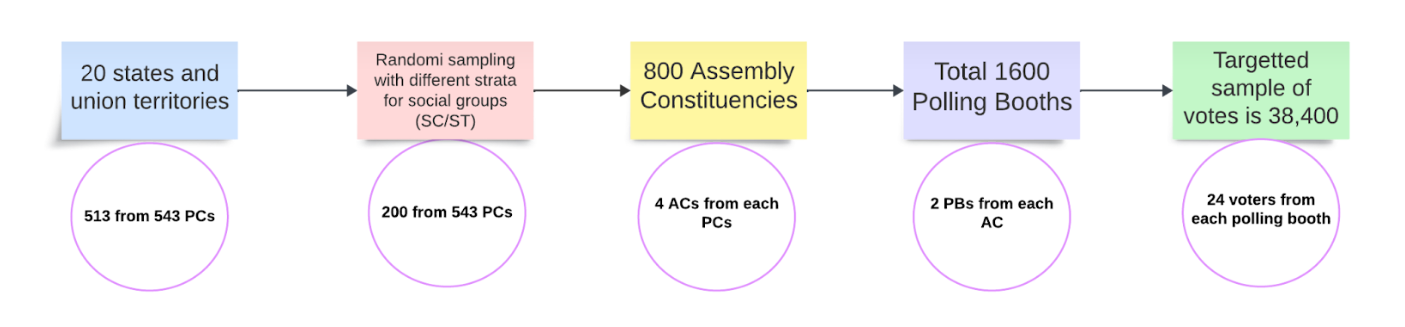
To conduct the survey, we randomly selected respondents from each polling booth (PB) and created a facepage for the enumerators to carry. This facepage included details of the parliamentary constituency (PC), assembly constituency (AC), and the PB, as well as information on the sampled and replacement respondents from each PB. This process ensured that enumerators reached the respondents selected randomly by the sample design, preventing any bias from personal selection. This unique sampling strategy, utilizing the electoral rolls for each PB, helps minimize post-estimation errors and allows for accurate tracking of respondents for future interactions.
The survey featured a comprehensive questionnaire covering various topics, including respondent backgrounds, electoral preferences, access to welfare schemes, preferences related to political leadership and governance, as well as questions on citizenship and media usage. We developed an extensive dictionary of state-specific and union government schemes tailored to each sampled state. Although this was a national survey, we invited our state teams to provide feedback and adjust questions, and allowed them to include a few state-specific questions, thus bridging regional and national concerns in the questionnaire.
In addition to English, the final survey was translated into several local Indian languages. Enumerators received training in these languages to ensure successful execution and minimize non-sampling errors. A separate note on weights, models and other post estimation would be posted with the data.